Buying Guides
ESD Mat Resistance Testing: What the Numbers Mean
How ESD mat resistance testing works: the static-dissipative surface and conductive backing ranges to expect, and what to confirm with a supplier before ordering.
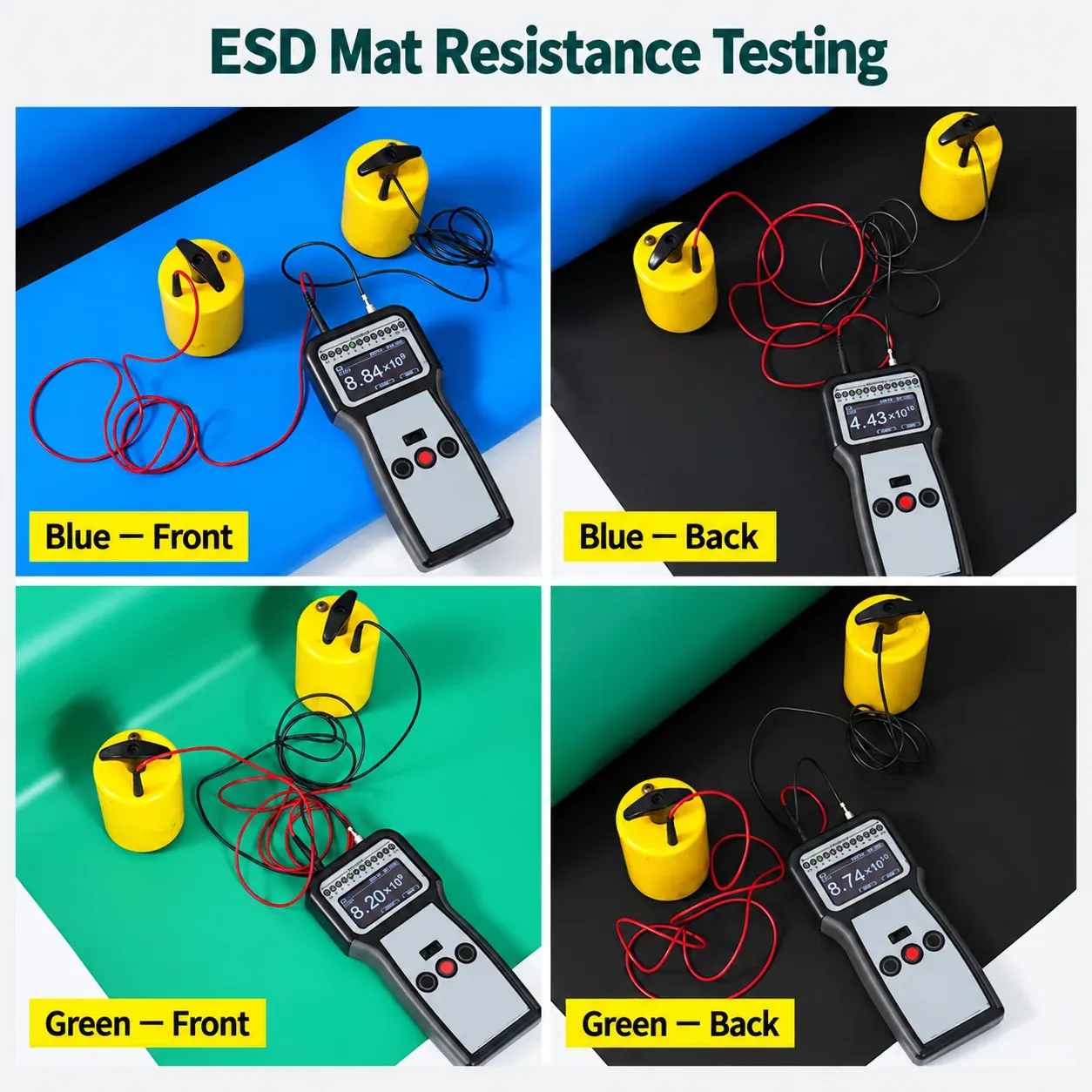
An ESD mat works by draining static charges from the work surface through a controlled resistance path - not by blocking them. That is why resistance is the number that defines a mat: it decides whether static flows away safely or stays on the bench. Resistance testing is how a mat proves it.
Two layers, two numbers
A two-layer ESD mat is measured on both layers. The working surface - the colored layer where components sit - should read in the static-dissipative range, typically 10⁶–10⁹ Ω. Fast enough to drain charges, slow enough to discharge them gently. The backing layer - black on most mats - is the conductive layer that carries the charge toward the ground connection, typically 10³–10⁵ Ω. When a supplier quotes both ranges in writing, you can compare mats on facts instead of photos.
How the testing is done
The standard tool is a handheld surface resistance meter with two weighted electrodes. The electrodes are placed on the working surface for one reading, then on the backing layer for a second reading - so both layers are verified, not just the one you can see. A mat that passes both readings will drain static in real use; a mat that fails one of them either holds charge on the surface or skips the path to ground. Testing matters at two moments: ask whether the supplier tests before shipment, and verify the batch yourself on receipt with your own meter.
What to confirm before ordering
Ask the supplier to state both resistance ranges in the quotation - the surface range and the backing range - together with the material and thickness. Confirm whether grounding snaps are installed at the factory and where they are positioned, because the test reading only becomes useful once the mat is connected to a proper ground. If your facility has its own resistance meter, mention it: suppliers can align the test method with the way you will verify on receipt.
Before you order
Send the intended application, the bench size and the quantity. Ask for the tested resistance ranges of both layers in writing, and request a sample if this is your first order - a supplier that supports small-batch orders and paid samples makes the first verification easy. The right mat is the one whose numbers you have seen, not just the one whose photos you liked.