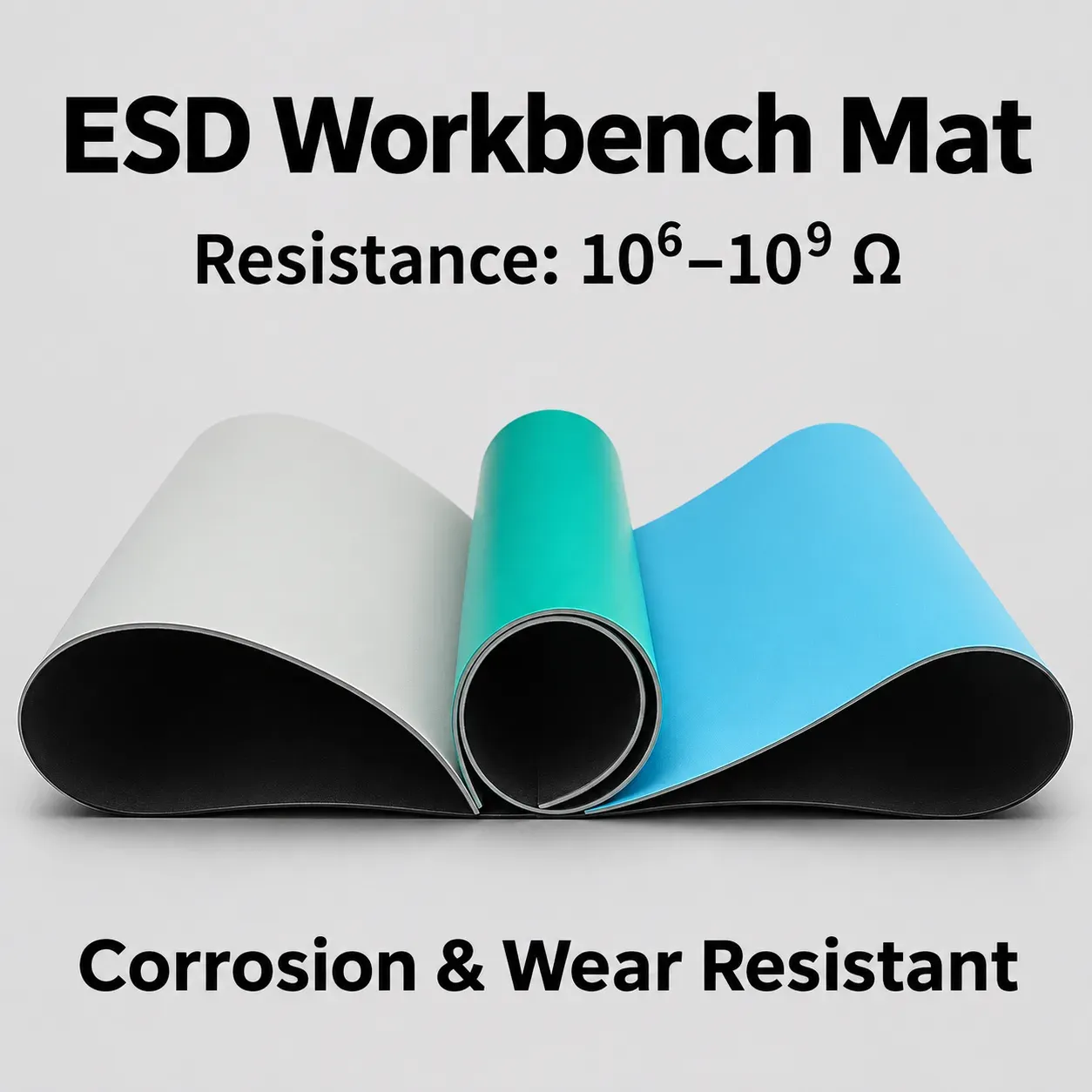
Thickness does not change static control — the dissipative top layer sets surface resistance (10⁶–10⁹ Ω) at any thickness. Use 2 mm for most benches, 3 mm where tools drop or parts are heavy, and 5 mm or thicker for floors and high-wear areas.
What thickness actually changes
An ESD table mat is a two-layer material: a static-dissipative top layer over a conductive black backing. The top layer's resistance is what drains static charge to the grounding snap, and it is the same on a 2 mm mat as on a 3 mm mat. What thickness changes is physical: cushioning under components, resistance to dropped tools and hot solder, how flat the mat lies, and how long the surface lasts in daily use.
Thickness compared
| Option | Best for | Notes |
|---|
| 2 mm | Everyday assembly, repair and laboratory benches | The standard bench thickness. Lies flat, easy to cut to size, and the thickness of our MS-E023 rubber mat's lighter option and our two-layer PVC mats. |
| 3 mm | Benches with heavy parts, frequent tool drops, soldering | More cushioning and puncture resistance. MS-E023 is available in 2 mm or 3 mm in blue and teal green. |
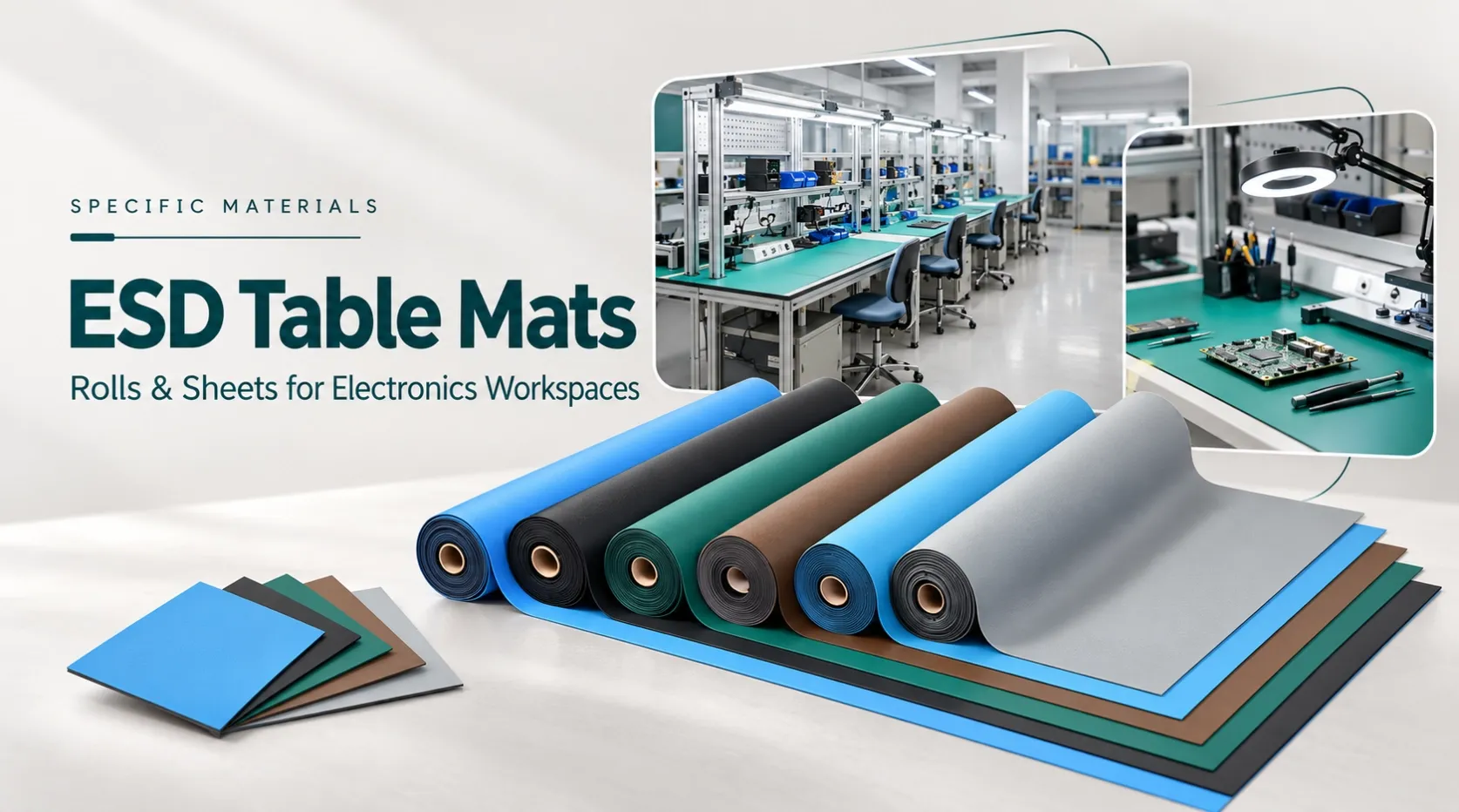
| 5 mm and above | Floor areas, standing workstations, high-wear zones | Sold as matting and sheet rolls — for example MS-E017 5 mm anti-static rubber matting and MS-E021 rubber sheet rolls in 1–10 mm — rather than as bench mats. |
How to choose
For a repair or assembly bench, start with 2 mm; it is what most electronics workstations use. Move to 3 mm if technicians drop tools on the mat, place heavy metal parts on it, or solder directly over it every day. For floors, walkways and standing stations, use matting of 5 mm or more — a bench mat is not made to be walked on. Whatever the thickness, the mat only works when it is grounded: fit a grounding snap and cord, as described in our grounding guide.
FAQ
Does a thicker ESD mat dissipate static better?
No. Dissipation is set by the top layer's surface resistance, which is 10⁶–10⁹ Ω across our range at every thickness. Thickness changes durability and cushioning, not electrical performance.
Which thickness is right for phone repair?
2 mm. Phone and small-device repair benches need a flat, stable surface more than cushioning, and 2 mm mats lie flattest and are easiest to cut to a small bench.
Can a thick mat be cut to a custom size?
Yes. Rolls and matting can be cut to your dimensions, and grounding snaps can be fitted at the positions you specify — the same custom-cutting service we offer for bench mats.
Does thickness affect how the mat is grounded?
No. Grounding is done through a snap fitted to the mat and a cord to a common ground point, the same way at any thickness.