Buying Guides
How to Order Custom-Cut ESD Mats?
Ordering custom-cut ESD mats? Learn what dimensions, drawings, material specifications and grounding details to provide before requesting a quotation.
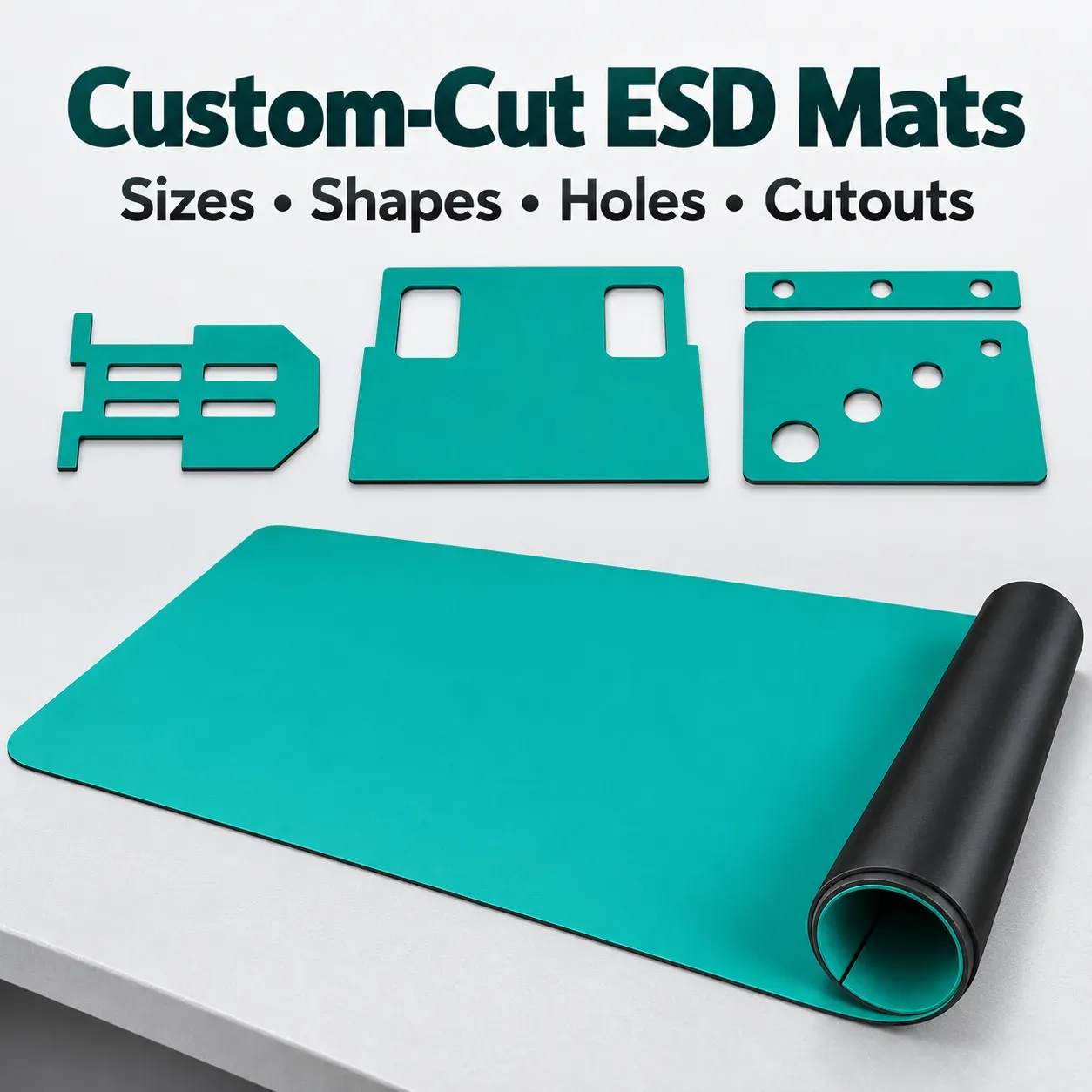
Custom-cut ESD mats can be specified to fit individual workbenches, assembly stations and equipment layouts. A clear order specification helps avoid incorrect dimensions, misplaced holes and unnecessary revisions.
Before requesting a quotation, prepare the finished dimensions, material requirements, quantity and a drawing of any cutouts. Grounding connections and electrical requirements should also be agreed before production.
1. Define Where the Mat Will Be Used
Start with the application. Will the mat cover an electronics assembly bench, a repair station or an inspection surface?
Describe the working conditions, including equipment placed on the mat, cleaning products used and any exposure to heated tools. These details help the supplier assess whether the proposed material is appropriate.
Specify whether you need one continuous piece or several separate mats. For multiple workstations, list each size and quantity rather than providing only a total area.
2. Provide the Finished Dimensions
Measure the area the mat needs to cover. State the finished length and width, and use one unit consistently throughout the order.
For example:
• Finished size: 1,200 × 600 mm
• Quantity: 20 pieces
• Shape: rectangle
• Corners: square
• Thickness: to be confirmed
This is an example of how to present an enquiry, not a standard product specification.
If the mat fits inside a recessed surface or between fixed fixtures, explain the available clearance. Do not assume the supplier will automatically make the mat smaller than your drawing.
3. Prepare a Drawing for Holes and Cutouts
A dimensioned drawing is important when the mat needs cable openings, equipment clearances, mounting holes or an irregular outline.
Your drawing should identify:
• Overall length and width
• Diameter of each circular hole
• Length and width of rectangular openings
• Hole and cutout positions measured from clearly marked edges
• Corner radii or chamfers
• Required dimensional tolerances
• The top working surface and installation orientation
A photograph can help explain the application, but it should not replace dimensions. If you provide a paper template, confirm how it will be measured and reproduced.
For repeat orders, give each design a part number and revision number. This helps prevent an earlier drawing from being used after the layout changes.
4. Confirm the Material and Thickness
Specify whether you require rubber, PVC or another approved ESD material. If you are unsure, describe the application and ask the supplier to propose an option for review.
Confirm the material construction, thickness, surface finish and color before approving the order. Similar-looking mats may have different electrical and physical properties.
Thickness should suit the workstation and equipment. A thicker mat does not automatically provide better ESD performance.
If heat or chemical exposure matters, request information for the exact material being quoted. Do not rely on a general description such as “heat resistant” without clarifying the working conditions.
5. State the Electrical Requirements
Custom dimensions do not replace the need for an appropriate electrical specification.
Provide the requirements from your organization’s ESD control plan. Clarify whether the specified values refer to resistance between points on the surface, resistance to ground or another measurement.
Agree on the relevant measurement method and acceptance criteria. Avoid comparing quotations based only on the words “anti-static” or “conductive.”
If you do not have a defined specification, involve the person responsible for your workstation’s ESD controls before approving the material.
6. Specify Grounding Connections and Accessories
Decide whether the mats should arrive with grounding connectors installed or whether installation will take place at your facility.
Where connectors are required, confirm:
• Connector type and size
• Number of connectors per mat
• Position measured from the finished edges
• Compatibility with the grounding cords
• Whether cords and other accessories are included
Mark the connector locations on the same drawing as the cutouts. This helps prevent a connector from being positioned underneath equipment or too close to an opening.
The finished mat must be integrated into the workstation’s grounding arrangement. Personnel grounding and other ESD controls should be addressed separately.
7. Confirm Tolerances and Approve a Sample
Ask the supplier to confirm achievable tolerances before placing the order. Cutting accuracy depends on the material, dimensions, shape and production method.
For mats that must fit closely around fixtures, consider a sample or first-piece approval. Check the fit on the actual workstation, including holes, corners, cutouts and grounding connections.
Record any approved changes in a revised drawing. Keep the final drawing and approved sample as references for production and future orders.
8. Agree on Packing and Delivery Details
Confirm how the finished mats will be packed and identified. If the order contains several designs, request labels that match your part numbers.
Provide the delivery country and postal code so shipping can be assessed. Ask the supplier to confirm the production schedule after the drawing, material and order details are approved.
For installation planning, also request guidance on unpacking and allowing rolled material to lie flat.
Custom ESD Mat Order Checklist
Before sending your enquiry, prepare:
• Application and working conditions
• Material preference and thickness
• Finished dimensions and units
• Quantity for each design
• Dimensioned drawing with revision number
• Hole, cutout and corner details
• Dimensional tolerances
• Electrical requirements
• Grounding connector locations and accessories
• Packing requirements and delivery destination
Frequently Asked Questions
Can I order a custom-cut ESD mat without a CAD drawing?
A clear dimensioned sketch may be enough for a simple shape, subject to supplier confirmation. More complex designs may require a CAD file. Ask which file formats are accepted before preparing the artwork.
Are grounding cords included?
Do not assume they are included. Request a quotation that clearly separates the mat, installed connectors and grounding accessories.
Can different sizes be included in one order?
Ask the supplier to confirm. List the dimensions and quantity of each size, as minimum quantities and production costs may differ between designs.
Should I approve a sample before ordering several mats?
A sample is useful when the mat must fit around fixed equipment or when the material is new to your workstation. Approve both the physical fit and the agreed performance requirements.
Discuss Your Custom-Cut ESD Mat Requirements
Send Specific Materials your required dimensions, quantity and intended application. For holes or irregular shapes, attach a dimensioned drawing.
Include your preferred material, thickness and grounding requirements so we can review feasibility and prepare a quotation based on your actual workstation layout.