Buying Guides
ESD Mat Surface Resistance Classes: Conductive, Dissipative and Insulative Explained
Short answer: ESD mats fall into three resistance classes: conductive, dissipative and insulative. The class decides whether static drains away safely, drains too fast, or stays on the bench. This guide explains the three classes, the numbers behind them, and which class a workbench mat should be.
The three classes
Resistance is measured in ohms (Ω). The class of a surface is set by its surface resistance, and the three bands used across the industry are:
Class | Surface resistance | What it does with static | Workbench use |
|---|---|---|---|
Conductive | Below 10⁴ Ω | Drains charge very fast | Conductive backing layer of a two-layer mat; not a work surface on its own |
Static dissipative | 10⁴ Ω to below 10¹¹ Ω | Drains charge at a controlled rate | The work surface of an ESD table mat |
Insulative | 10¹¹ Ω and above | Holds charge on the surface |
A workbench mat belongs in the dissipative band. The standard ANSI/ESD S20.20 requires a worksurface resistance below 1 × 10⁹ Ω, measured point-to-point and point-to-ground. The often-quoted 10⁶ Ω lower bound is industry practice rather than a requirement written in the standard itself — the standard sets the upper limit; the lower bound is a working recommendation.
Why the middle band is the right one
A dissipative surface drains a charge fast enough to protect components, and slow enough to discharge it gently. That balance is the whole point of a two-layer mat: the top layer controls the drain rate, and the conductive backing underneath carries the charge to ground.
- Too fast (conductive): a bare conductive surface dumps a charge in one fast event, which can damage a sensitive device instead of protecting it.
- Too slow (insulative): an insulating surface does not drain at all, so charge builds up on the bench until it discharges through the next thing that touches it — often a component.
- Controlled (dissipative): the charge leaves the surface at a measured rate through the mat and the ground connection.
What our mats measure
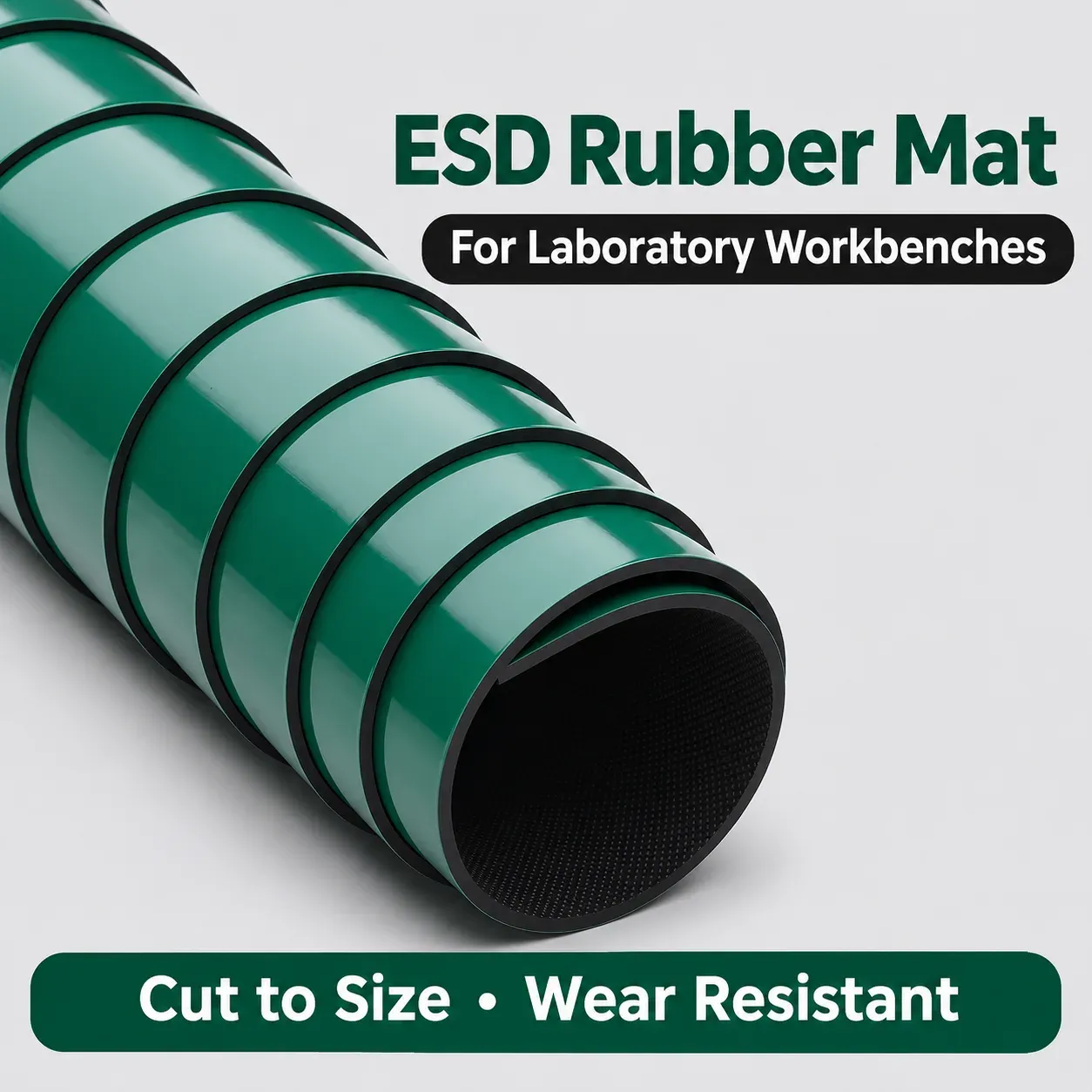
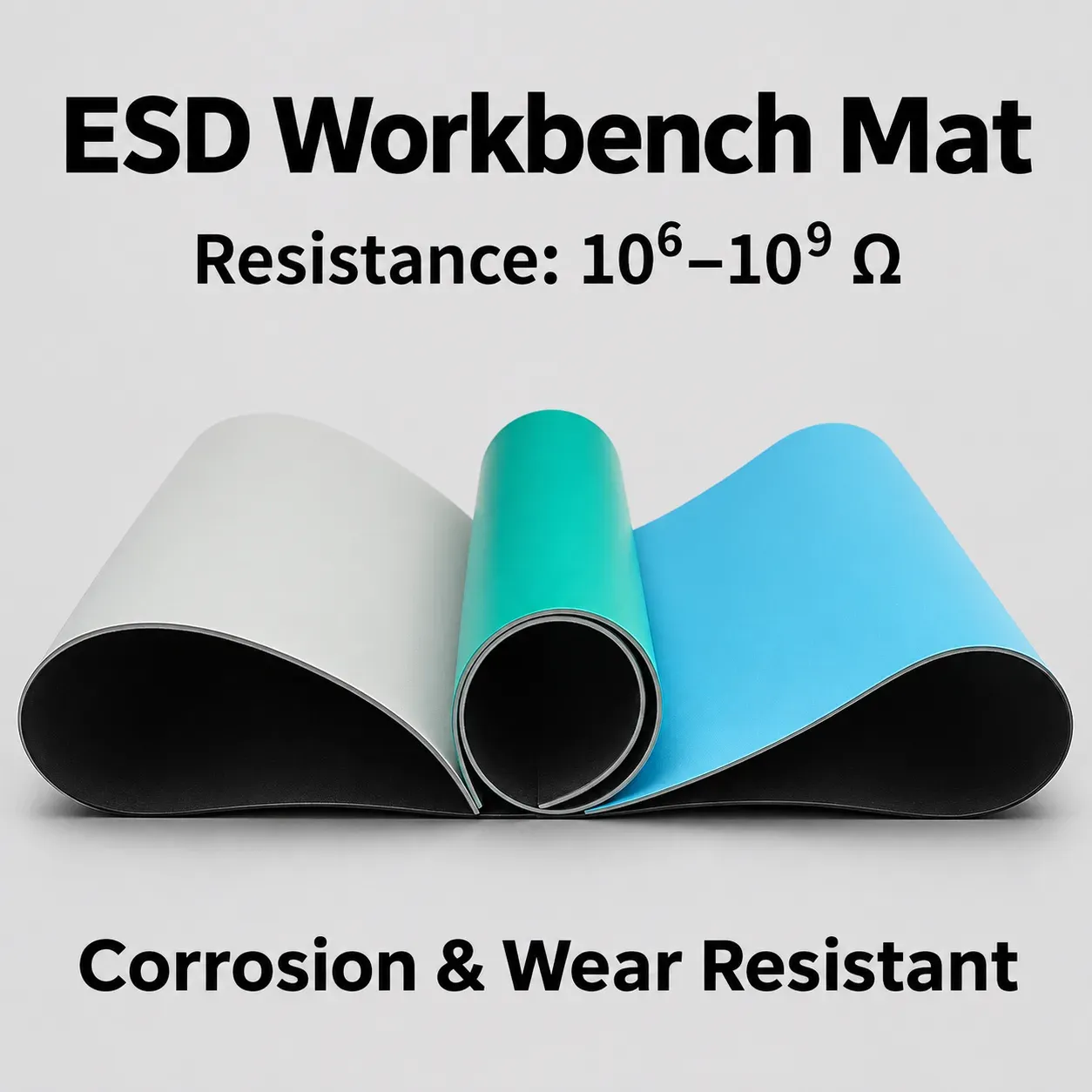
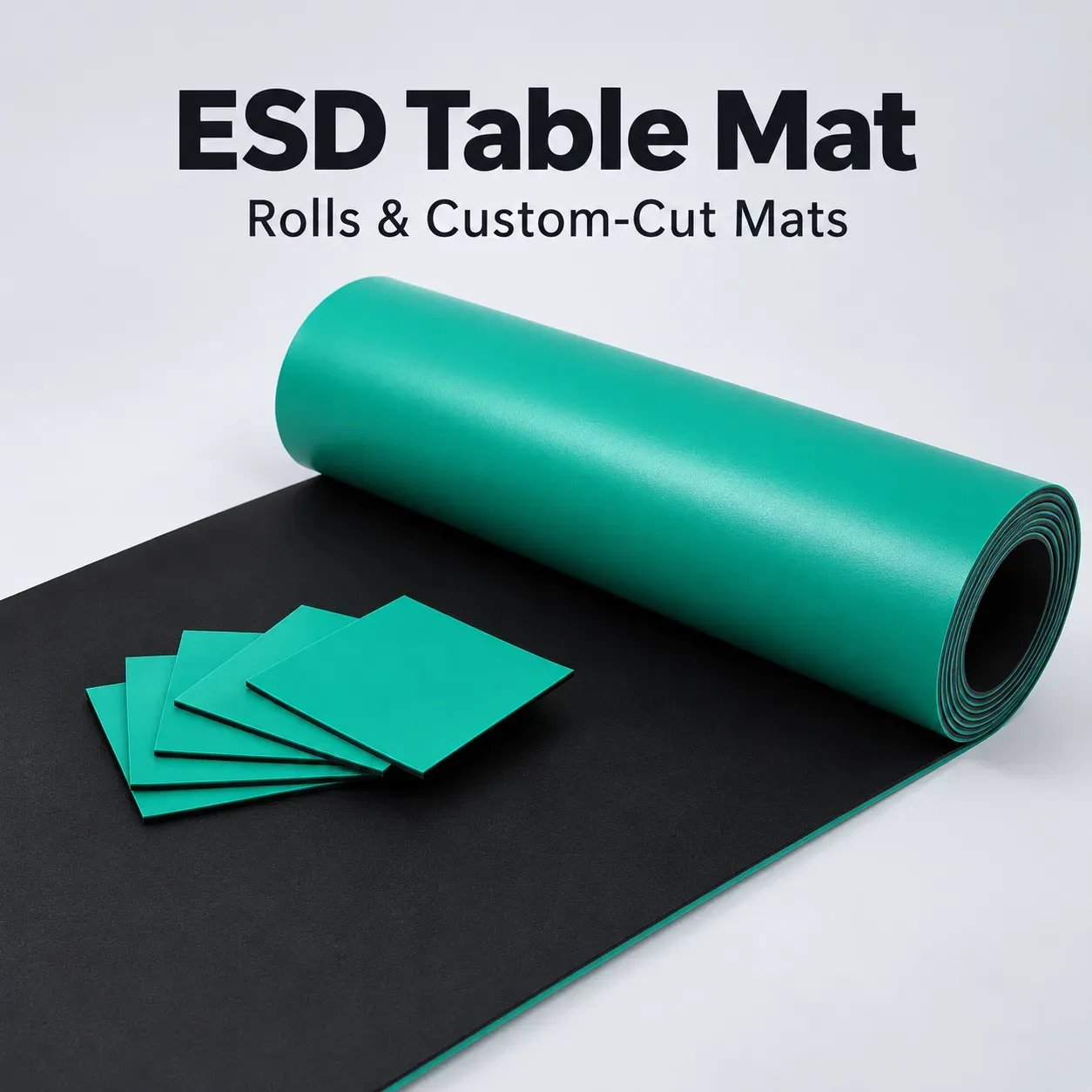
The MS-E001 PVC ESD table mat, a standard model in the range, is built as a two-layer mat: a coloured static-dissipative top layer over a black conductive backing layer. Its published figures are a surface resistance of 10⁶–10⁹ Ω and a backing resistance of 10³–10⁵ Ω, with a static decay time of under 0.1 seconds. The surface sits inside the dissipative band and below the 10⁹ Ω worksurface limit; the backing sits inside the conductive band, where it belongs — it is the path to ground, not the surface components touch. Standard thickness is 2 mm, and mats are supplied as rolls or cut to the required size, with grounding snaps installed at the positions the buyer specifies.
How to use the classes when buying
- Ask for both numbers, not one. A mat is two layers: the surface figure and the backing figure. A supplier that states only one has not described the mat.
- Check the surface figure against the dissipative band. For a workbench mat, the surface should read 10⁶–10⁹ Ω. A surface reading at or above 10¹¹ Ω is an insulating surface, not an ESD work surface.
- Check the backing figure separately. The backing should read in the conductive range, around 10³–10⁵ Ω. If the backing reads dissipative, the path to ground is slower than the mat was designed for.
- Verify on receipt. Ask whether the supplier tests before shipment, and verify the batch yourself with a surface resistance meter: one reading on the working surface, one on the backing layer. The testing method is covered in the resistance-testing guide linked below.
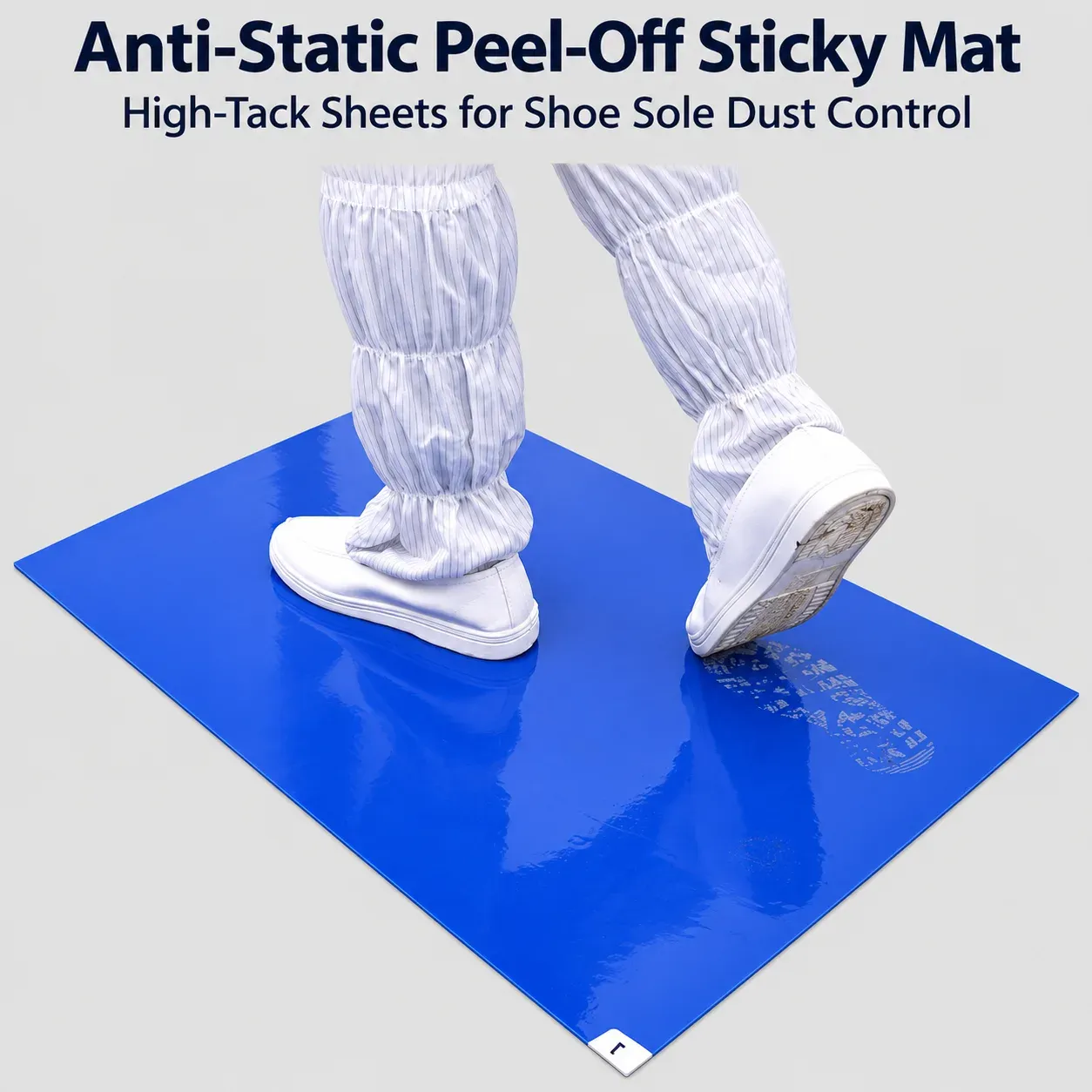
- Do not confuse a sticky mat with an ESD mat. A cleanroom sticky mat traps dust at the entrance; it is not a static-dissipative work surface and does not replace a grounded ESD mat. The sticky-mat comparison explains the difference.
FAQ
What resistance should an ESD table mat surface have?
A static-dissipative surface, 10⁶–10⁹ Ω. ANSI/ESD S20.20 requires a worksurface below 1 × 10⁹ Ω, measured point-to-point and point-to-ground.
What is the difference between conductive and dissipative?
Both drain charge, at different rates. Conductive surfaces (below 10⁴ Ω) drain very fast and are used for the backing layer that carries charge to ground. Dissipative surfaces (10⁴ Ω to below 10¹¹ Ω) drain at a controlled rate and are used for the surface components touch.
Is an insulating mat the same as an ESD mat?
No. An insulating surface (10¹¹ Ω and above) holds charge instead of draining it, so it cannot serve as an ESD work surface. Insulating mats have their own uses, away from static-sensitive work.
Why does a mat need two different resistance numbers?
Because it has two jobs. The top layer sets the drain rate at the surface; the backing layer provides the path to ground. Both are tested separately with a surface resistance meter.
Can a sticky mat replace an ESD mat?
No. A sticky mat controls particles at a doorway; it does not drain static and is not grounded as a work surface. The two products solve different problems and are often used in the same facility, in different places.
What should I ask the supplier before ordering?
Ask for the surface and backing resistance ranges in writing, the material and thickness, whether grounding snaps are factory-installed and where, and whether the batch is tested before shipment.
Bottom line
Buy the class, not the colour. A workbench mat needs a dissipative surface (10⁶–10⁹ Ω) over a conductive backing (10³–10⁵ Ω), verified on both layers before the order ships. Read the resistance-testing guide for the measurement method, or send the bench size and quantity for a quotation on the model that fits.