Buying Guides
How Two-Layer ESD Table Mats Work
A two-layer ESD mat pairs a dissipative top with a conductive black backing. How each layer works, the published resistance values, and what to check.
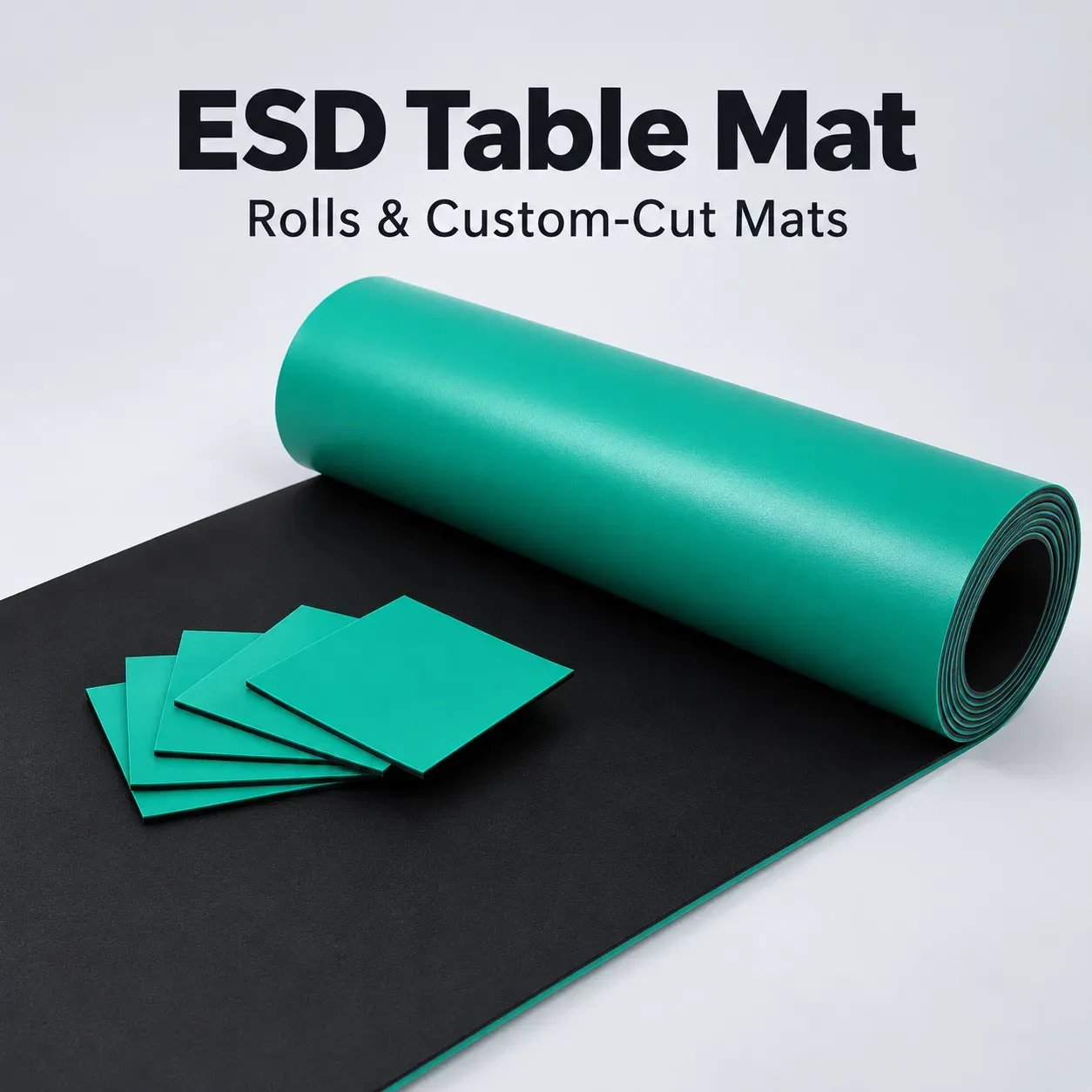
A two-layer ESD table mat works as a pair: a static-dissipative top layer drains charge from the work surface slowly, and a black conductive backing carries it to ground. The top surface measures 10⁶–10⁹ Ω on the models that publish it; the backing measures 10³–10⁵ Ω.
What the two layers are
Across the MS-E001–MS-E026 range, the construction is the same where it is described: a static-dissipative coloured top layer over a black conductive backing layer. Nine product pages name PVC as the base material and eleven name rubber; six pages describe the two-layer construction without naming a base material. The top layer is the coloured working surface — green, blue, gray or black on the PVC models, usually a green surface on the rubber models — and the backing is black throughout the range.
What each layer does
Top layer (dissipative) — drains charge slowly. Its published surface resistance is 10⁶–10⁹ Ω on eleven models: MS-E001, MS-E002, MS-E003, MS-E004, MS-E005, MS-E007, MS-E008, MS-E017, MS-E021, MS-E023 and MS-E025. Two pages state it differently: MS-E013 publishes 10⁷–10⁹ Ω for its green surface, and MS-E020 publishes a top-surface volume resistance of 1.0 × 10⁵ to 1.0 × 10⁸ Ω rather than a surface resistance. The slow drain is the point: a dissipative surface lets charge leave the work area in a controlled way instead of discharging in a single fast event. For what the three resistance classes mean, see ESD mat surface resistance classes (https://specificmaterials.com/posts/esd-mat-surface-resistance-classes-conductive-dissipative-and-insulative-explained).
Backing layer (conductive) — carries charge to ground. Its published resistance is 10³–10⁵ Ω on several product pages, and 10³–10⁶ Ω on MS-E025. The backing is the layer that connects to the grounding point: grounding snaps can be fitted at the positions specified with the order, and the mat is grounded through a cord from the snap to a common ground point. For the grounding steps, see how to ground an ESD mat (https://specificmaterials.com/posts/how-to-ground-an-esd-mat).
How thick is each layer?
Only one model in the range publishes a per-layer thickness: MS-E010 is 2 mm in total, made of a 1 mm top and a 1 mm backing. Every other model publishes a total thickness only — the PVC models that publish one are all 2 mm, the rubber bench mats run 2–3 mm, MS-E015 and MS-E017 offer 2, 3 and 5 mm, and the MS-E021 and MS-E022 sheet rolls run from 1 mm to 10 mm. Where a page does not publish a thickness, it is confirmed with the enquiry. For what thickness changes in use, see the ESD mat thickness guide (https://specificmaterials.com/posts/esd-mat-thickness-how-to-choose-2mm-3mm).
Why two layers instead of one
Layer | Function | Published resistance | Thickness published |
|---|---|---|---|
Top (dissipative) | Drains charge from the work surface slowly | 10⁶–10⁹ Ω (eleven models); MS-E013: 10⁷–10⁹ Ω | 1 mm on MS-E010 only |
Backing (conductive) | Carries charge to the grounding point | 10³–10⁵ Ω (several pages); MS-E025: 10³–10⁶ Ω | 1 mm on MS-E010 only |
A single dissipative sheet with no conductive backing would have no defined path to ground; a single conductive sheet would discharge too fast for sensitive components. The two-layer build separates the two jobs: the top sets the drain rate, the backing sets the path to ground. That is also why the two resistance values are checked separately — a mat can pass on the top surface and fail on the backing, or the other way round.
Single-model data points worth knowing
A few pages publish values that do not fit a shared column but matter for specific orders: MS-E017 publishes a hardness of 60° ± 5°, and MS-E001 publishes a short-term temperature resistance of 260 °C. Static decay time is published on some pages. None of these are range-wide figures — they belong to the model named, so check the model's own page before quoting them.
What to check before ordering
- Material first. PVC or rubber decides the thickness range and the colour set: see PVC vs rubber ESD table mats (https://specificmaterials.com/posts/pvc-vs-rubber-esd-table-mats).
- Resistance values as published. Start from the eleven models that publish 10⁶–10⁹ Ω if the value must be documented before ordering, and confirm the test method with the enquiry.
- Thickness and supply form. Fixed 2 mm PVC, 2/3/5 mm rubber, or 1–10 mm rolls — compare all 26 models in the 26-model table (https://specificmaterials.com/posts/esd-table-mats-and-sheet-rolls-all-26-models-compared).
- Grounding snap positions. State them when sending the drawing or dimensions; snaps are fitted where specified.
- Colour. Green, blue, gray and black is the standard set on the PVC models; most rubber models are a green surface over a black backing. On the models that publish both, the same 10⁶–10⁹ Ω range appears across colours.
- Order quantity. No product page in the MS-E001–MS-E026 range publishes an MOQ; the pages state that order quantities suit sample evaluation, trial sales and workstation projects, and paid samples are available on several models.
FAQ
Which layer touches the work?
The dissipative top layer is the working surface. The black conductive backing faces the bench and connects to ground.
What resistance should the top surface have?
10⁶–10⁹ Ω on the eleven models that publish a surface resistance. MS-E013 publishes 10⁷–10⁹ Ω for its green surface, and MS-E020 publishes a volume resistance instead — read those two rows as written on their product pages.
What does the backing layer measure?
10³–10⁵ Ω on the pages that publish it, and 10³–10⁶ Ω on MS-E025. The backing is the conductive path to the grounding point.
How thick is each layer?
Only MS-E010 publishes per-layer thickness: 1 mm top plus 1 mm backing, 2 mm total. Other models publish total thickness only, so per-layer thickness is confirmed with the enquiry where it matters.
Can grounding snaps be fitted?
Yes. Grounding snaps can be installed at the positions specified with the order — state the positions when sending the drawing or dimensions.
Does colour affect performance?
On the models that publish both, the same 10⁶–10⁹ Ω range appears across colours, so colour is a finish choice, not a performance one. The standard set is green, blue, gray and black on the PVC models; most rubber models are a green surface over a black backing.
Bottom line
A two-layer ESD mat is two jobs in one product: the top controls how fast charge drains, the backing carries it to ground. Check both resistance values on the model's own page, confirm thickness and snap positions with the enquiry, and start from the 26-model comparison (https://specificmaterials.com/posts/esd-table-mats-and-sheet-rolls-all-26-models-compared) to narrow the range.