Buying Guides
PVC vs Rubber ESD Table Mats: Which Material to Choose?
PVC vs rubber ESD table mats compared on thickness, surface resistance, colours and supply form, using only values published on the 26 model pages.
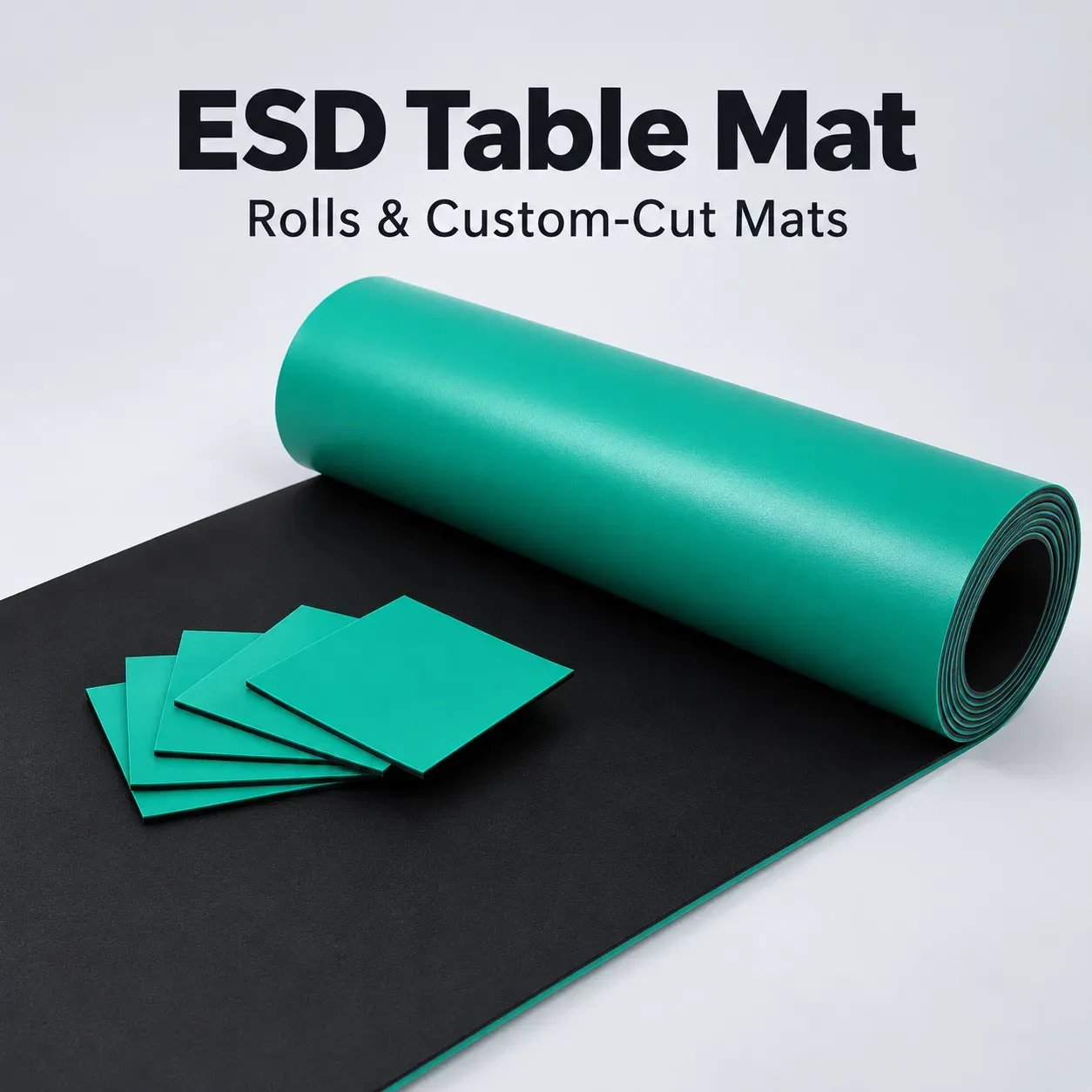
Short answer: PVC and rubber are the two materials used for ESD table mats. PVC models are 2 mm; rubber models span 2 to 10 mm. Both use a dissipative top over a conductive backing, and most models publish 10⁶–10⁹ Ω surface resistance.
The two materials compared
| PVC models | Rubber models |
|---|---|---|
Models naming the material | 9 of 26 | 11 of 26 |
Thickness published | All 2 mm | 2–3 mm bench mats; 2 / 3 / 5 mm sheets; 1–10 mm rolls |
Surface resistance published | 10⁶–10⁹ Ω on most models | 10⁶–10⁹ Ω on most models |
Colours | Green, blue, gray, black standard | Mostly green surface over black backing |
Supply form | Rolls or sheets, widths up to 1.5 m; custom-cut | Rolls or cut-to-size sheets; rolls 10 m × 1 m or 1.2 m |
Six of the 26 pages describe a two-layer construction without naming the base material. Where the construction is described, both families are the same build: a static-dissipative coloured top layer over a black conductive backing layer.
Thickness: where the materials differ
Thickness is the real difference between the two materials. Every PVC model that publishes a thickness is 2 mm. The rubber models cover the wider span: 2–3 mm bench mats, 2 / 3 / 5 mm sheets, and 1–10 mm sheet rolls. For what thickness changes in use, see the ESD mat thickness guide (https://specificmaterials.com/posts/esd-mat-thickness-how-to-choose-2mm-3mm).
One construction detail is published on a single model: MS-E010 is a 2 mm mat made of a 1 mm top layer over a 1 mm backing layer.
Resistance: where they do not differ
Eleven models publish a surface resistance of 10⁶–10⁹ Ω, spread across both materials — the material does not decide the resistance class. Two pages state their resistance differently and should be read as written: MS-E013 publishes 10⁷–10⁹ Ω for its green surface, and MS-E020 publishes a top-surface volume resistance of 1.0 × 10⁵ to 1.0 × 10⁸ Ω rather than a surface resistance. Backing-layer resistance of 10³–10⁵ Ω is published on several pages, and 10³–10⁶ Ω on MS-E025. For the resistance classes themselves, see ESD mat surface resistance classes (https://specificmaterials.com/posts/esd-mat-surface-resistance-classes-conductive-dissipative-and-insulative-explained).
Colours and finish
The PVC models publish the widest colour choice: green, blue, gray and black is the standard set on MS-E001, MS-E002, MS-E004 and MS-E020, with white, brown and apple green on request for MS-E002. Most rubber models are a green surface over a black backing. Two rubber models add finish options: MS-E023 and MS-E024 come in matte and glossy finishes, and MS-E026 is blue with options in black, coffee brown, gray, sky blue and green.
Sizes and supply form
Most models are cut to the customer's dimensions rather than sold in fixed mat sizes. Fixed roll dimensions exist on three models: MS-E021 and MS-E022 are rubber sheet rolls of 10 m × 1 m or 1.2 m in thicknesses from 1 mm to 10 mm, and MS-E010 is a 2 mm roll, 10 m long, in seven widths from 0.4 m to 1.5 m. Custom cutting is offered across the range, including holes, notches, rounded corners and cutouts — MS-E003 is manufactured to your drawing, and MS-E018 is cut into sheets, rings and custom shapes. Grounding snaps can be installed at the positions you specify; state the positions when you send the drawing.
No product page in the MS-E001–MS-E026 range publishes an MOQ. The pages state that order quantities suit sample evaluation, trial sales and workstation projects, and that paid samples are available on several models.
Frequently Asked Questions
Which material should we choose for a standard workbench?
If the bench needs a fixed 2 mm mat in a choice of colours, start with the PVC models MS-E001 to MS-E004 and MS-E007 — they publish the full set of material, thickness, resistance and colours. If the bench needs a thicker mat, the rubber models are the only ones that publish 3 mm and 5 mm.
Does the material change the surface resistance?
No. Eleven models publish 10⁶–10⁹ Ω across both materials, so the material does not decide the resistance class. Check the resistance value on the page of the model you choose — thirteen of the 26 pages do not publish one, and it has to be confirmed with the enquiry.
Which material covers a large area?
The rubber sheet rolls. MS-E021 and MS-E022 are 10 m × 1 m or 1.2 m rolls in thicknesses from 1 mm to 10 mm, and MS-E010 is a 2 mm roll, 10 m long, in seven widths from 0.4 m to 1.5 m.
Can both materials be cut to a non-standard size or shape?
Yes, according to the product pages. Custom cutting is offered across the range, including holes, notches, rounded corners and cutouts. MS-E003 is manufactured to your drawing, and MS-E018 is cut into sheets, rings and custom shapes.
Is there a minimum order quantity?
No product page in the MS-E001–MS-E026 range publishes an MOQ. The pages state that order quantities suit sample evaluation, trial sales and workstation projects. Send your dimensions, thickness and quantity, and the quotation confirms the available options for that model.